
The Argentine Route of Art Nouveau in Tucumán
The Argentine Route of Art Nouveau in Tucumán
San Miguel de Tucumán was designated an “Art Nouveau City 2025” for its examples of Art Nouveau architecture.
Art Nouveau was an international artistic style that emerged between the late 19th and early 20th centuries, characterized by its fluid lines and curves inspired by nature, especially plant forms. It manifested itself in various disciplines such as architecture, decorative arts, painting, and sculpture, seeking a unified and modern aesthetic that broke with previous conventions.
The buildings and monuments that make up the Art Nouveau Route in Tucumán are described below:
Government House
Designed by architect Domingo Selva, the Government House of Tucumán is an eclectic palace where French luxury blends with Baroque style. Although not strictly Art Nouveau, the use of iron, glass, and details in the interior halls, especially the White Hall, reflect the decorative opulence of the era. Art Nouveau appears in the interiors: the glass shades, the details of the original elevators, and the wrought ironwork of the grand staircase demonstrate the influence of modern design from 1910.
It is worth noting that Tucumán boasts the only Art Nouveau Government Palace in Latin America and the second in the world, after the Government Palace in Prague, the capital of the Czech Republic.
Location: 25 de Mayo 90 - San Miguel de Tucumán
Statue of Liberty
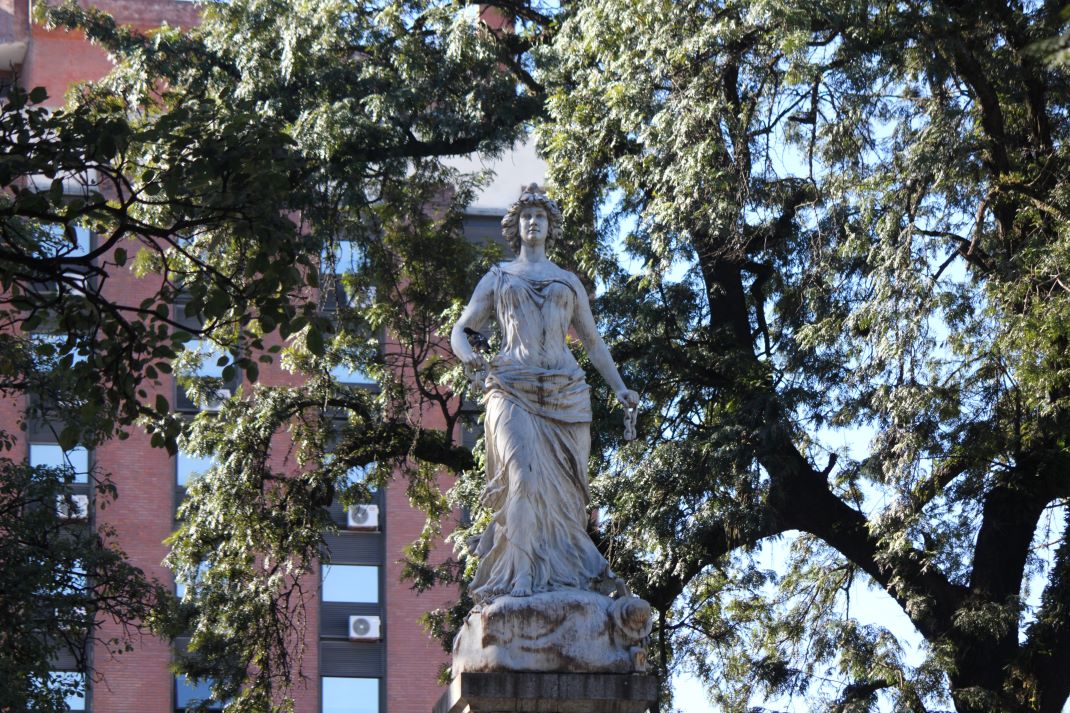
Sculpted in Carrara marble by the renowned Tucumán artist Lola Mora, the Statue of Liberty graces Independence Square in San Miguel de Tucumán. Although Neoclassical in style, the dynamism of the drapery and the expressive power of the female figure break with academic rigidity, evoking the sensibility of the Belle Époque. While Lola Mora trained in Neoclassicism, the movement of the fabrics and the breaking of the chains possess a vital energy that aligns with the spirit of Art Nouveau: the triumph of nature and freedom over rigidity.
Location: Independence Square - San Miguel de Tucumán
Former Plaza Hotel - Mercedes Sosa Theater
Designed by architect José Pasteris and located across from Plaza Independencia, the former Plaza Hotel, now home to the Mercedes Sosa Theater, is one of the purest examples of the Viennese Secession in the city. This is evident in the geometry of its details, the straight lines combined with circles, and the elegant restraint that distinguishes it from the more "floral" French Art Nouveau. Squares, circles, and sharply defined straight lines are prominent. It does not seek to realistically imitate nature, but rather in a more abstract and elegant way. It is a truly avant-garde building for its time.
Location: San Martín 435 - San Miguel de Tucumán
Former Sucar House - City Museum SMT
Constituted as a restored jewel of the city, this building represents the aristocratic residence of the "Centennial Generation." Its exterior ornamentation and interiors reflect the luxury and artisanal detail of European modernism adapted to the local context of Tucumán. It is a living catalog of the style. Its limestone mosaic floors with floral motifs, its colorful stained-glass windows, and the iron marquee at the entrance are examples of early 20th-century industrial design.
Location: Salta 500 - San Miguel de Tucumán
Monument to Juan Bautista Alberdi
A masterpiece by the renowned Tucumán sculptor Lola Mora, this monument stands out for its integration of the political figure of Juan Bautista Alberdi with sculptural allegories full of movement and symbolism, characteristic of the visual language of the early 1900s. The base of the monument features figures that intertwine organically, eliminating right angles, an aesthetic characteristic shared with European modernism.
Location: Plaza Alberdi - San Miguel de Tucumán
Provincial Historical Archive
The building that houses the Provincial Historical Archive is a key element. Its structure is notable for its verticality and the sculptural details at the top. It represents the administrative elegance typical of Tucumán during the Centennial of Independence. The building shows Belgian/French influences. Its ornamentation is highly sculptural, with lines that seem to "melt" or flow around the portholes and upper windows.
Location: 25 de Mayo 487 - San Miguel de Tucumán
Sarmiento Society
Built by engineer Domingo Selva and inaugurated in 1909, this building is an example of eclecticism with a strong decorative element. Its façade features a symmetrical composition where moldings and artistic ironwork stand out, characteristic of the era when the Tucumán bourgeoisie sought to modernize the city of San Miguel de Tucumán. This style is evident in the decoration of the friezes and the corbels supporting the balconies, which feature stylized plant motifs. The interior retains an iron and glass skylight that floods the main staircase with light. Belonging to the Sarmiento Society, founded in 1882 as the Ateneo de las Provincias (Athenaeum of the Provinces), the building's halls were frequented by prominent figures from Tucumán, Argentina, and the world, such as José Ortega y Gasset and Georges Clemenceau, who made it a beacon of thought in Northern Argentina.
Location: Congreso de Tucumán 65 - San Miguel de Tucumán
Faculty of Arts, UNT
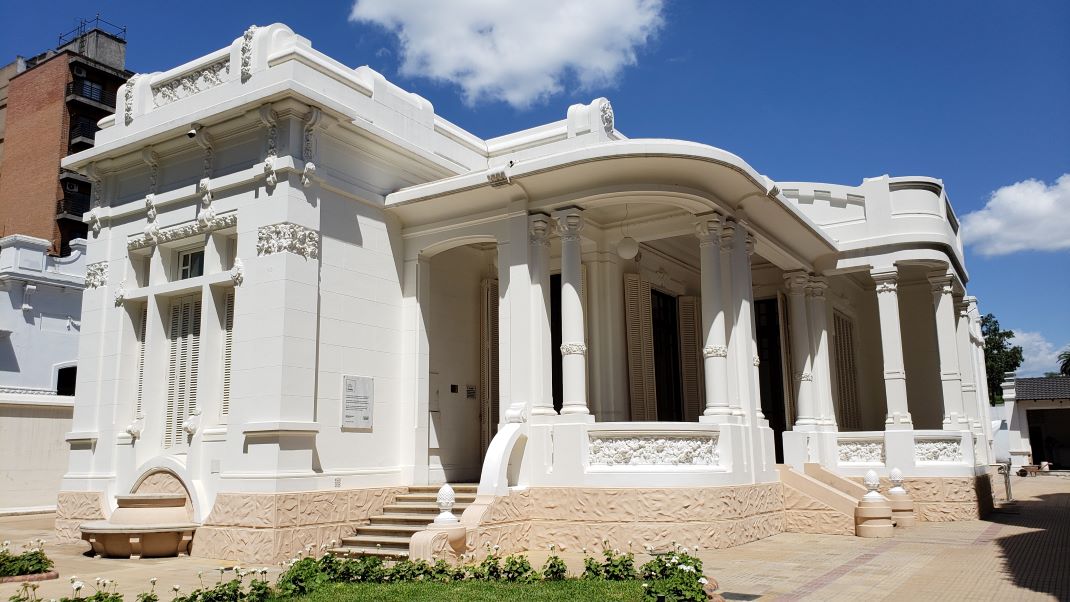
Originally part of a country estate or manor house, the building that now houses the Faculty of Arts of the National University of Tucumán presents an imposing presence with ornamental details in the friezes and openings that reflect the modernist style of the era. This is evident in the ornate plasterwork of the façade, which includes bas-reliefs of female figures or masks intertwined with flowers, typical of the French influence on the style.
Location: Simón Bolóvar 700 - San Miguel de Tucumán
Hotel Congreso Colonial
Although its name evokes the colonial era due to its proximity to the Casa Histórica de la Independencia Museum, the building retains details characteristic of early 20th-century architecture, with ornamentation that blends classical elements with more fluid lines. These details are found in the woodwork and hardware. The window grilles are not rectilinear but feature smooth curves ("whiplash"), a distinctive feature of modernism.
Police Station No. 2 (1901)
This building, which houses Police Station No. 2 in Tucumán, is a fascinating example of institutional architecture. The details on its façade show a transition to Art Nouveau, especially in the treatment of curves and the ornamentation of the windows. The building's crowning element (the highest part) features undulating curves that break with the straight line of the roof. The windows have frames with decorative "ears" that flow downwards.
Location: Buenos Aires 479 - San Miguel de Tucumán

