
El Palancho, a family united by art
El Palancho, a family united by art
Discover this family business based in Amaicha del Valle.


They say some skills seem to be with us from the beginning, almost as if we were born with them. That's the case for Clara Guerra, owner of the El Palancho business in Amaicha del Valle, who has had a spindle in her hands since she was a child. “My cousins ??and I grew up with our great-grandmother, and our favorite toy was the spindle. She taught us to weave, to spin, to twist, to warp. We helped her because she was old,” recalls the 70-year-old, who has kept this artistic tradition alive since she was 15 and who has now found in her daughter Julieta the heir to her legacy.
Before becoming a vest, saddlebag, or poncho—some of the pieces Clara makes—the wool must undergo a careful preparation process. “It consists of cleaning it, chalking it, and then spinning it according to what you want to make,” she explains. Each creation requires patience and dedication: a scarf or vest for a child may require a week of spinning, while a wool blanket or quilt may require between 15 and 20 days of work.
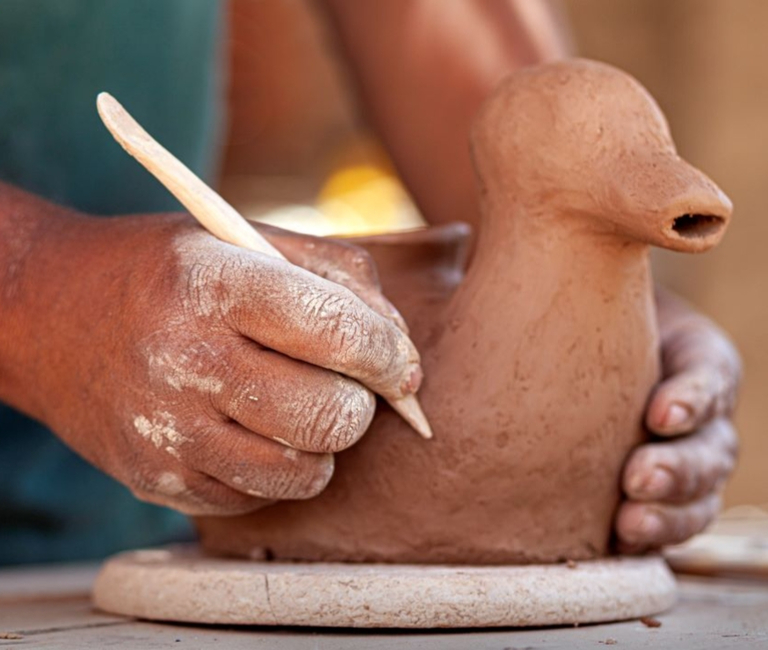
Álvaro Lazarte, Clara's son, also inherited the family's creativity, but he channeled it into clay. He learned by talking with local artisans and making use of new technologies and the internet, tools also used by younger generations. "I always try to keep learning new techniques," he says, convinced of the importance of continuous training.
He explains that the process begins with extracting the clay from the river quarry. "There are two varieties: mineral clay, which is obtained in its natural, raw state, and river clay, which is formed from the tiles deposited by the river's flow," he explains. The tiles are then broken and soaked for a couple of days until they disintegrate; then they are sifted and filtered. Once the material is dry, the piece can be shaped, either by hand or with a mold. Next, it is polished and roughed out, smoothing the surfaces with sponges or stones. Finally, the piece rests for several weeks until it loses all its moisture and is then fired in the kiln. Lazarte points out that each artisan has his own oven model and his own firing technique.
Her crafts are diverse: from utilitarian objects—like kettles, cups, and plates with designs inspired by local animals—to artistic ceramics and reconstructions of indigenous pieces. “This is my livelihood. I know my pieces have value, and they help me make ends meet,” she says.
This mother and her children sustain, with the power of their hands, not only their home but also an ancient culture that chose them as custodians of immense creativity.

